Table of Contents19
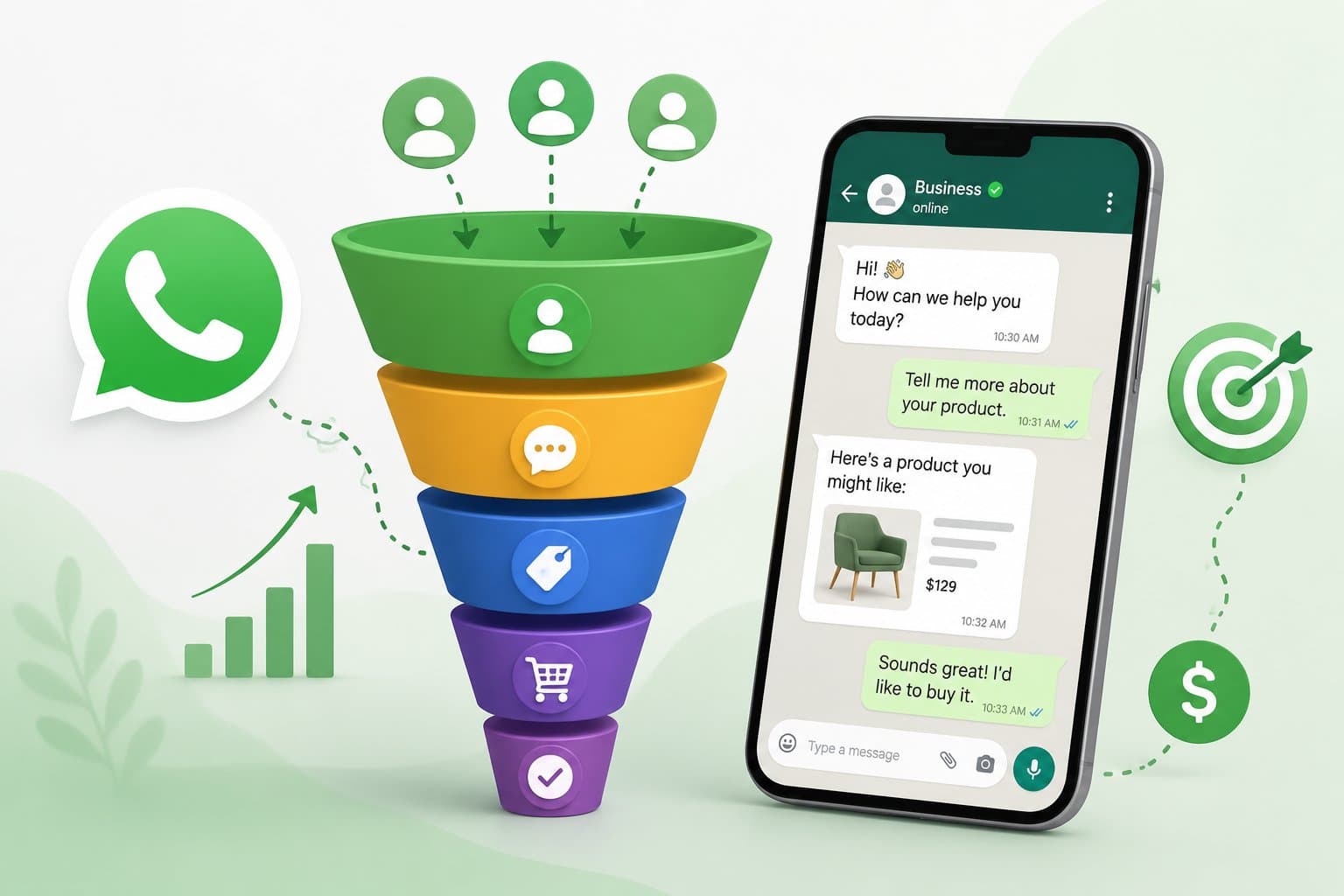
WhatsApp Sales Funnel strategy helps businesses turn conversations into customers through a structured process that moves users from first interaction to conversion.
Customer expectations have changed. People want quick responses and simpler ways to communicate with businesses. Instead of filling out long forms or waiting for email replies, many users prefer sending a message and receiving an immediate response.
A well-built WhatsApp sales funnel helps organize those conversations. This guide explains how WhatsApp sales funnels work, the stages involved, how to build one, and how businesses use automation to improve conversions.
What Is WhatsApp Sales Funnel?
A WhatsApp sales funnel is a process designed to guide potential customers through different stages before they take action. That action could be purchasing a product, booking a demo, requesting a consultation, or submitting a lead.
Unlike regular chat conversations, a WhatsApp sales funnel follows a structured flow. Each interaction has a purpose and moves users closer toward a specific outcome.
Regular Chat | WhatsApp Sales Funnel |
|---|---|
Random conversations | Structured process |
Manual responses | Automated workflows |
No lead tracking | Lead management |
No follow-ups | Follow-up sequence |
Hard to measure | Performance tracking |
How WhatsApp Sales Funnel Works
WhatsApp sales funnel starts by bringing people into a conversation and gradually moving them toward conversion.
Instead of treating every message as a separate interaction, the process creates a customer journey that can be measured and optimized.
Traffic Source
↓
WhatsApp Conversation Starts
↓
Lead Qualification
↓
Personalized Response
↓
Purchase or Booking
↓
Follow-Up & Retention
The goal is to reduce friction and make it easier for users to complete an action.
The 5 Stages of a WhatsApp Sales Funnel
Every WhatsApp Sales Funnel Strategy typically follows five major stages.
Stage | Purpose | Example |
|---|---|---|
Awareness | Bring users into WhatsApp | Ads, QR codes |
Interest | Capture attention | Welcome messages |
Consideration | Build trust | Reviews and FAQs |
Conversion | Generate action | Purchase or booking |
Retention | Encourage repeat activity | Follow-up campaigns |
Each stage serves a different purpose, but together they create a complete customer journey.
How to Build a WhatsApp Sales Funnel Strategy
Building a funnel starts with defining a clear objective. Without a goal, it becomes difficult to measure whether the process is successful.
1. Define your conversion goal
The conversion goal depends on the business type.
Common examples include:
Product purchases
Appointment bookings
Demo requests
Lead collection
2. Bring traffic into WhatsApp
People need an entry point before conversations can begin.
Common sources include Click-to-WhatsApp ads, website widgets, QR codes, social media campaigns, and email marketing.
3. Qualify leads automatically
Lead qualification helps businesses understand customer needs before sales teams spend time responding.
Questions often include:
What product are you looking for?
What is your budget range?
What problem are you trying to solve?
4. Create automation and follow-ups
Automation becomes important as conversation volume increases.
Businesses commonly automate welcome messages, reminders, FAQs, and follow-up sequences to reduce repetitive work.
Related Articles:
7 Ways to Automate WhatsApp Replies for Your Business
WhatsApp CRM for Business: What You Need to Know
How AI Responds to Customers and Improves Response Time
5. Connect CRM and AI tools
Many businesses now connect WhatsApp with CRM platforms and AI tools to centralize customer interactions.
Solutions such as Xcent AI can help automate lead routing, organize customer data, and reduce manual sales activities through AI-powered workflows.
6. Track performance
Track important metrics like response time, conversion rate, drop-off rate, and lead quality. These numbers help identify weak areas and improve your funnel over time.
WhatsApp Sales Funnel Example
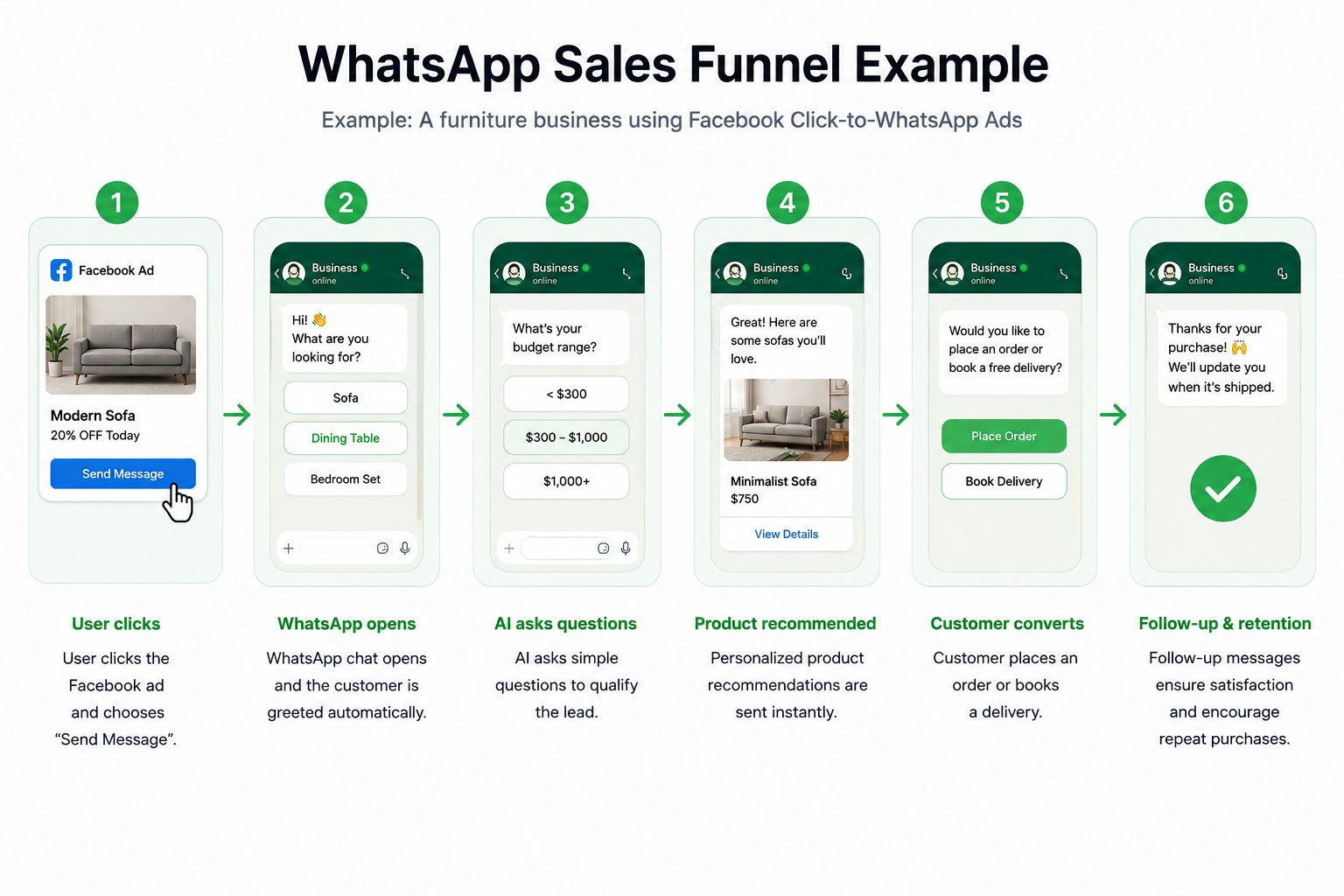
Whatsapp Sales Funnel Example A
A furniture business wants to generate more inquiries from Facebook ads.
Instead of sending visitors to a website form, the company directs users into WhatsApp where the conversation starts immediately.
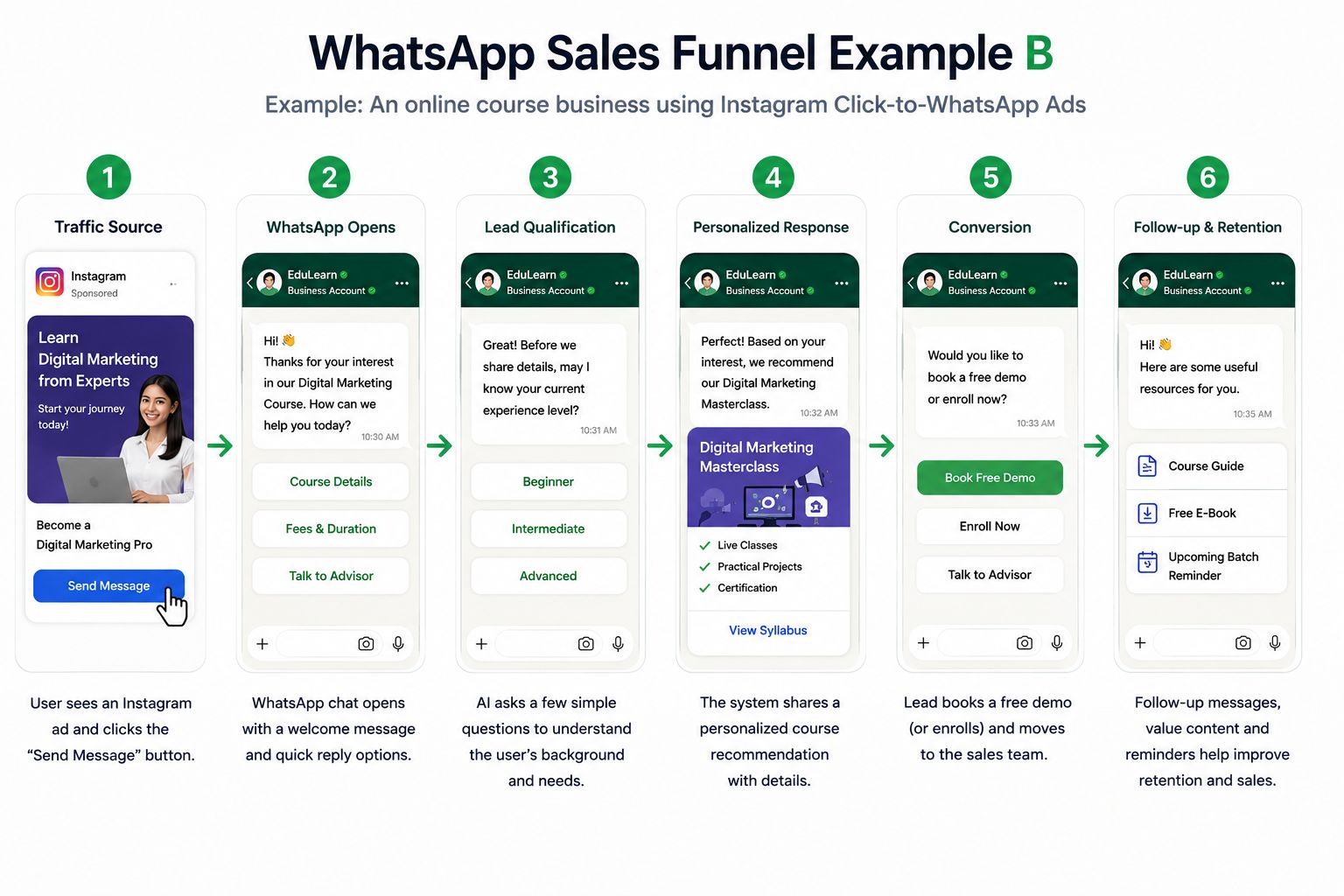
Whatsapp Sales Funnel Example B
This example shows how an online course business uses Instagram Click-to-WhatsApp Ads to guide users from interest to enrollment. AI helps qualify leads, recommend relevant courses, and automate follow-ups to improve conversion and retention.
Frequently Asked Questions
1. Can WhatsApp increase conversion rates?
Yes. WhatsApp creates faster and more direct communication, which can reduce friction and improve customer engagement.
2. What is the difference between WhatsApp marketing and WhatsApp sales funnel?
WhatsApp marketing focuses on attracting and engaging audiences, while a WhatsApp sales funnel focuses on guiding users toward conversion.
3. Can AI automate a WhatsApp sales funnel?
Yes. AI can automate lead qualification, answer common questions, send follow-ups, and route conversations automatically.
4. Which businesses benefit most from WhatsApp funnels?
E-commerce, education, healthcare, real estate, agencies, financial services, and local businesses commonly benefit from WhatsApp-based sales workflows.
Conclusion
A WhatsApp Sales Funnel strategy gives businesses a structured way to turn conversations into measurable outcomes. Instead of relying on disconnected chats, businesses can create a repeatable process that supports customer acquisition and retention.
As AI and CRM integration become more common in 2026, businesses increasingly automate customer conversations to improve efficiency. Xcent AI helps businesses connect AI, CRM, and automation tools into a unified workflow that supports faster responses and smarter lead management.
Explore Xcent AI solutions or sign up today to improve your sales workflow.