WhatsApp Business App vs WhatsApp API: What’s the Difference?

Table of Contents21
If your business uses WhatsApp to talk to customers, one of the biggest decisions you will face is choosing between the WhatsApp Business App vs WhatsApp API. Although both are built by WhatsApp for business communication, they are designed for very different types of companies.
The WhatsApp Business App is best for small businesses that only need a simple way to reply to customers. Meanwhile, the WhatsApp Business API is built for companies that need automation, multiple agents, CRM integration, and the ability to handle a high volume of messages.
Understanding the difference between WhatsApp Business App vs WhatsApp API is important because the wrong choice can slow down your customer service, make sales harder to manage, and limit your business growth. In this guide, you will learn how both solutions work, their key differences, which one is more suitable for your business, and when it may be time to upgrade.
What Is the WhatsApp Business App?
The WhatsApp Business App is a free application created for small businesses. It works similarly to the regular WhatsApp app, but it includes extra features that help business owners communicate with customers more professionally.
Most small shops, freelancers, online sellers, restaurants, and local businesses start with the WhatsApp Business App because it is easy to download and use. You only need a phone number to create a business account.
Unlike the WhatsApp API, the app is designed for businesses with low message volume and only one or a few people managing customer chats.
Pros of WhatsApp Business App
The biggest advantage of the WhatsApp Business App is that it is simple and free.
Business owners can create a professional business profile that includes:
Business name
Address
Business hours
Website
Email address
The app also includes helpful built-in features such as:
Product catalogs to showcase products or services
Quick replies to answer common questions faster
Labels to organize chats and customers
Greeting messages for new customers
Away messages when the business is offline
These features make the WhatsApp Business App a good option for businesses that receive a small number of inquiries each day and do not need advanced tools.
For example, a small clothing store or home bakery can use the app to answer customer questions, send product photos, and manage orders without paying for additional software.
Limitations of WhatsApp Business App
Although the WhatsApp Business App is useful for small businesses, it has several limitations.
First, it is difficult to use when multiple employees need access to the same account. The app is mainly designed for one user and can only support a limited number of connected devices.
Second, it has very limited automation. Businesses can create simple greeting or away messages, but they cannot build advanced chatbot flows, automated lead qualification, or customer journey automation.
The app also does not integrate directly with:
CRM systems
Helpdesk software
Sales pipelines
Marketing automation tools
As the number of customer messages increases, the WhatsApp Business App can quickly become difficult to manage. Businesses may experience slower response times, missed messages, and confusion between team members.
What Is WhatsApp API?
The WhatsApp API, also known as the WhatsApp Business API, is a more advanced solution designed for medium-sized and large businesses.
Unlike the WhatsApp Business App, the API cannot be downloaded directly from the App Store or Google Play. Businesses need to access it through an official WhatsApp Business Solution Provider or customer communication platform.
The WhatsApp API is built for businesses that receive hundreds or even thousands of messages. It allows companies to connect WhatsApp with other business tools such as CRM software, chatbot platforms, helpdesk systems, and sales management software.
For growing businesses, the WhatsApp API provides better scalability, automation, and team collaboration.
Main Features of WhatsApp API
One of the biggest reasons businesses choose the WhatsApp Business API is because it offers features that are not available in the standard app.
1. Multi-User Access
The WhatsApp API allows multiple agents or departments to use the same WhatsApp number at the same time. This is useful for businesses that have separate sales, support, and marketing teams.
Instead of one person replying to all messages, companies can assign conversations to different team members and handle customer inquiries more efficiently.
2. Automation and Chatbots
The WhatsApp API supports advanced automation. Businesses can create automated replies, chatbot conversations, lead qualification flows, appointment reminders, abandoned cart messages, and more.
For example, an e-commerce business can automatically:
Reply when a customer asks about a product
Send order confirmation messages
Follow up on abandoned carts
Route customers to the right sales agent
This makes the WhatsApp API much more powerful than the WhatsApp Business App.
3. CRM and Software Integration
One of the most important differences in the WhatsApp Business App vs WhatsApp API comparison is integration.
The WhatsApp API can connect with:
CRM software
Customer support platforms
Marketing tools
ERP systems
Internal business workflows
Because of this, businesses can see the full customer history, track leads, manage sales pipelines, and personalize communication.
4. Broadcast Messaging and Templates
The WhatsApp API allows businesses to send approved message templates to customers. These can include:
Promotional messages
Appointment reminders
Payment notifications
Shipping updates
Customer support follow-ups
This feature is especially useful for companies that need to contact many customers at once.
5. Analytics and Reporting
The WhatsApp API also gives businesses access to reporting tools. Companies can track:
Response time
Number of messages
Team performance
Customer satisfaction
Sales conversion rates
These insights help businesses improve customer communication and make better decisions.
Who Should Use WhatsApp API?
The WhatsApp Business API is ideal for businesses that:
Receive a high number of customer messages
Have multiple team members handling chats
Need chatbot or automation features
Want to integrate WhatsApp with a CRM
Need better reporting and customer tracking
For example, companies in e-commerce, healthcare, education, real estate, travel, and financial services often use the WhatsApp API because they need more advanced communication tools.
WhatsApp Business App vs WhatsApp API: Key Differences
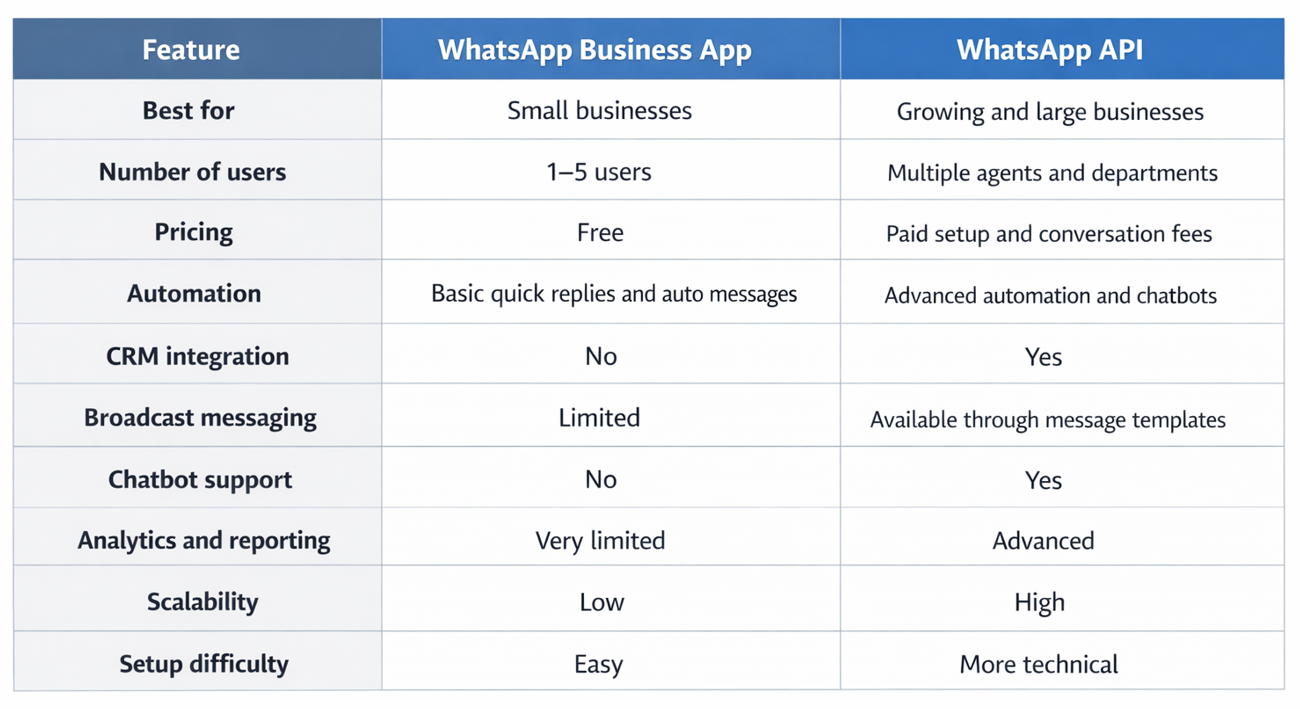
Now that you understand how both solutions work, it is easier to compare the WhatsApp Business App vs WhatsApp API side by side.
While both are designed for business communication on WhatsApp, they differ significantly in terms of cost, scalability, automation, integrations, and team management.
1. Pricing
The WhatsApp Business App is free to use. Businesses only need to download the app and register their number.
The WhatsApp API, however, usually involves additional costs. Businesses may need to pay for:
Platform subscription fees
API setup costs
Conversation-based WhatsApp charges
Although the API costs more, it often saves time and improves efficiency for growing businesses.
2. Number of Users
The WhatsApp Business App is designed for one person or a very small team.
The WhatsApp API supports multiple users at the same time. Sales agents, customer service teams, and managers can all access the same account without sharing a single phone.
3. Automation Capabilities
The WhatsApp Business App only supports basic automation such as greeting messages and quick replies.
The WhatsApp API supports advanced business automation including:
Chatbots
Automated workflows
Lead qualification
Auto-routing
Personalized follow-up messages
This is one of the biggest differences between WhatsApp Business App and WhatsApp API.
4. CRM and Third-Party Integration
The WhatsApp Business App works mostly as a standalone app.
The WhatsApp API can integrate with CRM software and other business systems. This means businesses can connect customer conversations directly to their sales process and support operations.
5. Customer Support at Scale
When a business only receives a few messages each day, the WhatsApp Business App may be enough.
But if the company receives dozens or hundreds of messages daily, the API is usually the better choice. It allows teams to organize conversations, reduce response time, and avoid missing customer inquiries.
6. Security and Access Control
The WhatsApp Business App has limited access control because the account is usually connected to one device or phone number.
The WhatsApp API offers better security and role-based access. Businesses can decide which team members can view or reply to messages.
Related Articles:
WhatsApp CRM for Business: What You Need to Know
How to Automate Sales Lead Follow Up in WhatsApp and CRM
7 Ways to Automate WhatsApp Replies for Your Business
Comparison Table: WhatsApp Business App vs WhatsApp API
When Should You Upgrade from WhatsApp Business App to WhatsApp API?
Many businesses begin with the WhatsApp Business App because it is simple and free. However, as the business grows, there usually comes a point when the app is no longer enough.
If your team struggles to keep up with customer conversations, upgrading to the WhatsApp API may be the right move.
Signs Your Business Has Outgrown the App
You should consider moving from WhatsApp Business App to WhatsApp API if:
You receive too many messages every day
Multiple employees need access to the same WhatsApp account
Customers complain about slow replies
You want to connect WhatsApp to your CRM
You need a chatbot or automated replies
You want better reporting and performance tracking
Businesses that continue using the app even after they outgrow it often lose sales opportunities because messages are missed or delayed.
Real Example Scenario
Imagine a small online store that starts with one owner replying to customers through the WhatsApp Business App.
At first, it works well because the business only receives a few inquiries each day.
However, after the store grows, it begins receiving hundreds of messages every week. More employees need access to the account, customers want faster replies, and the business wants to follow up automatically with abandoned cart reminders.
At this stage, the WhatsApp Business App becomes difficult to manage. The business needs the WhatsApp API to support multiple agents, automation, and integration with its CRM system.
Which One Is Better for Your Business?
There is no single answer in the WhatsApp Business App vs WhatsApp API debate because the best option depends on your business size, customer volume, and goals.
Choose WhatsApp Business App If…
The WhatsApp Business App is probably the best choice if:
You are a small business or solo entrepreneur
You only have one or two people handling chats
You receive a low number of customer inquiries
You do not need CRM integration or advanced automation
For many small businesses, the app is enough to manage day-to-day customer communication.
Choose WhatsApp API If…
The WhatsApp API is the better choice if:
Your business is growing quickly
You have a sales or support team
You need multiple users on one WhatsApp account
You want automation and chatbot support
You want to integrate WhatsApp with your CRM or other software
You need better analytics and customer tracking
If you want to scale customer communication, improve response times, and manage leads more effectively, the WhatsApp API is usually the smarter long-term option.
How Xcent AI Helps Businesses Use WhatsApp API More Effectively
Choosing the WhatsApp API is only the first step. To get the best results, businesses also need the right software to manage conversations, automate workflows, and connect customer data.
Xcent AI helps businesses turn the WhatsApp Business API into a complete sales and customer communication system.
With Xcent AI CRM software, your team can:
Connect and manage WhatsApp API in one platform
Let multiple sales and support agents handle customer conversations
Track leads and customer history in a built-in CRM
Automate replies, follow-ups, and customer journeys
Build chatbot flows without complicated setup
Assign conversations automatically to the right team member
Monitor team performance and response times
Instead of using WhatsApp only as a messaging app, Xcent AI helps businesses use it as a complete customer engagement and sales platform.
For businesses that are ready to move beyond the limitations of the WhatsApp Business App, Xcent AI makes it easier to adopt the WhatsApp API and scale customer communication.
If you want to improve response times, manage more leads, and grow your business with WhatsApp automation, contact the Xcent AI team today to see how the platform can help your business.