Table of Contents19
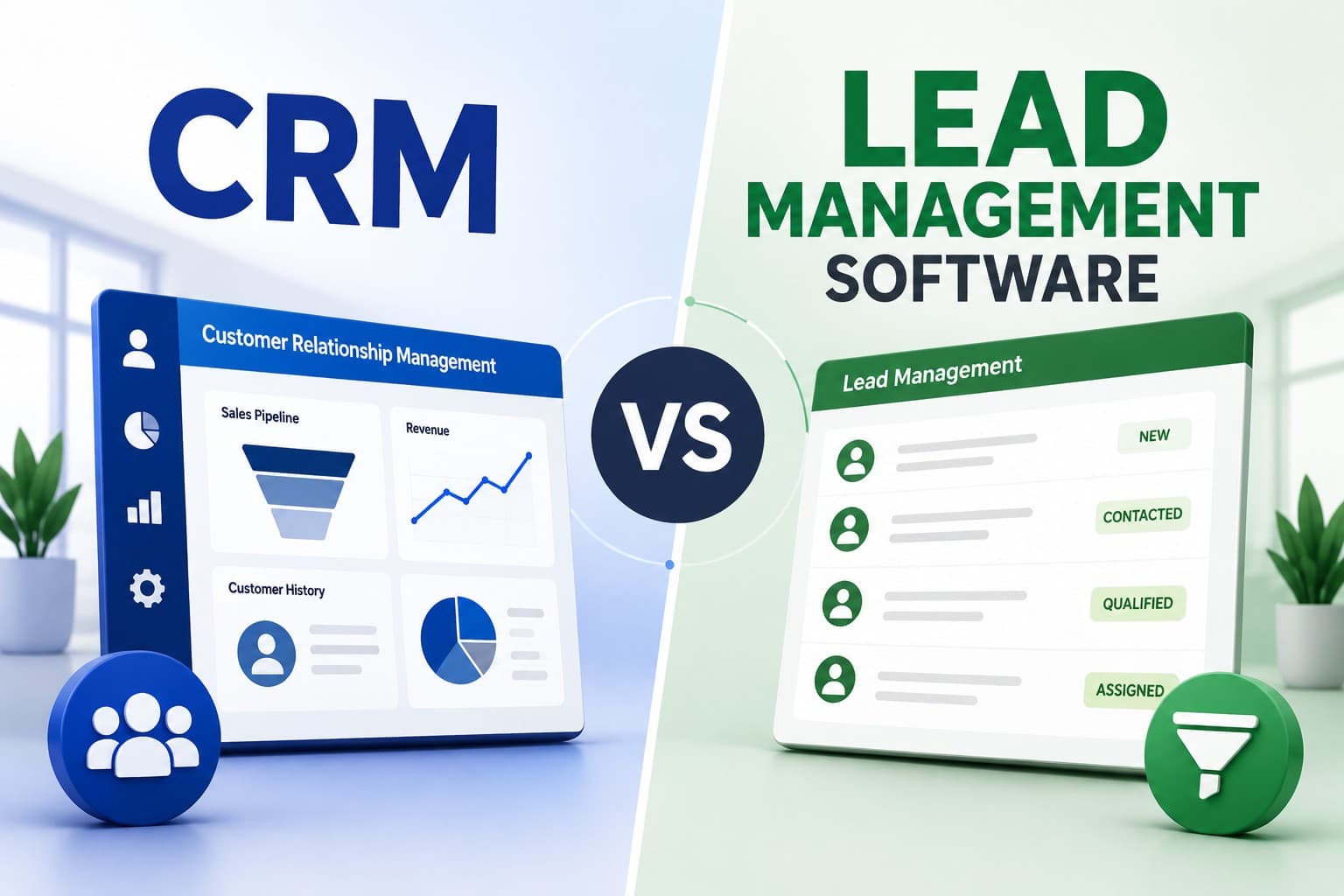
CRM vs lead management software is a common comparison for businesses looking to improve their sales process. Although both help manage leads, they serve different purposes.
Lead management software focuses on capturing, qualifying, and assigning new leads. CRM goes beyond that by managing customer relationships, sales activities, and follow-ups in one system. Understanding the difference can help you choose the right solution for your business.
CRM vs Lead Management Software: Key Differences
At first glance, CRM and lead management software may seem similar because both organize sales opportunities. However, the biggest difference is how much of the sales process they manage.
Feature | CRM Software | Lead Management Software |
|---|---|---|
Main purpose | Manage sales and customer relationships | Capture and organize leads |
Customer stage | Leads and existing customers | Mainly new leads |
Lead qualification | ✔️ | ✔️ |
Lead assignment | ✔️ | ✔️ |
Sales pipeline | ✔️ | Limited |
Customer history | ✔️ | Limited |
Workflow automation | ✔️ | Basic |
Best for | Growing sales teams | Businesses focused on lead generation |
1. Scope of Management
Lead management software is designed to organize potential customers before they become paying customers. CRM covers a broader process by managing leads, sales opportunities, customer interactions, and ongoing relationships after a sale.
2. Lead Qualification
Both systems can help qualify leads, but the approach may differ. Lead management software often focuses on identifying sales-ready prospects, while CRM platforms can combine qualification with customer history, pipeline stages, and sales activities.
3. Lead Assignment
Assigning leads to the right salesperson helps reduce delays and improve response times. Many CRM platforms include automated lead assignment alongside other sales workflows, while lead management tools typically focus only on routing new leads.
4. Sales Pipeline
CRM provides a complete view of the sales pipeline, making it easier to track deals from the first inquiry to closing. Lead management software usually focuses on moving leads through the early stages before they become active opportunities.
5. Customer Management
The relationship doesn't end after a customer makes a purchase. CRM keeps customer information, conversation history, and follow-up activities in one place, while lead management software is mainly designed for pre-sale activities.
6. Automation
Both platforms can automate repetitive tasks. However, CRM usually supports broader automation, including follow-ups, task creation, customer communication, and sales workflows beyond lead management.
What Is Lead Management Software?
Lead management software helps businesses capture, organize, qualify, and assign new leads before they become customers. Its goal is to create a structured process so every inquiry is handled efficiently.
Common features include:
Lead capture
Lead qualification
Lead assignment
Lead routing
Lead status tracking
Basic follow-up automation
Conversion reporting
What Is CRM Software?
CRM (Customer Relationship Management) software helps businesses manage customer information, sales activities, and ongoing relationships throughout the sales process.
Besides handling leads, CRM also gives teams better visibility into customer interactions and sales performance.
Common CRM features include:
Contact management
Lead and opportunity management
Sales pipeline tracking
Customer interaction history
Workflow automation
Reporting and analytics
Team collaboration
Should You Choose CRM or Lead Management Software?
The right choice depends on your business goals.
If your main priority is managing new inquiries before they become customers, lead management software may be enough.
Lead management software is suitable if you need to:
Capture leads from multiple channels
Qualify potential customers
Assign leads automatically
Track lead status
Improve lead conversion
However, if your business is growing and needs to manage the entire sales process, CRM is often the better long-term investment.
CRM may be a better choice if you need to:
Manage both leads and customers
Track sales opportunities
Keep customer conversation history
Automate follow-ups
Monitor sales performance
Centralize customer data
How AI Makes CRM Even More Powerful
Modern CRM platforms are increasingly using AI to automate repetitive work and improve customer engagement. Instead of simply storing customer information, AI CRM can help sales teams respond faster and work more efficiently.
AI can help businesses:
Qualify leads based on predefined criteria
Respond to customer inquiries instantly
Automate follow-up messages
Route leads to the right salesperson
Reduce repetitive sales tasks
Support sales teams with AI-powered conversations
Related Articles:
Best AI CRM Tools for Small Businesses in 2026
Best CRM with AI Chatbot Integration in 2026
Best 7 CRM With Automation Features for Small Teams (2026)
Manage Leads More Efficiently With Xcent AI
As businesses grow, managing customer conversations across WhatsApp, Facebook, and other channels becomes more challenging. Using separate tools for messaging, CRM, and automation can also slow down sales teams.
Xcent AI brings these processes together in one AI CRM platform. Businesses can manage leads, connect customer conversations, automate workflows, and use AI Agents to handle common inquiries while keeping customer information organized in one place.
Plan | Price | Best For |
|---|---|---|
Free | RM0 | Small businesses getting started |
Pro | RM99/user/month | Growing sales teams |
Growth | RM199/user/month | Businesses with higher conversation volumes |
Frequently Asked Questions
1. Can CRM replace lead management software?
Yes, many modern CRM platforms include lead capture, qualification, assignment, and follow-up features. For many businesses, a CRM can replace standalone lead management software, depending on the features provided.
2. Is lead management software only for sales teams?
No. Marketing and customer service teams may also use lead management software to organize inquiries, qualify prospects, and ensure leads are routed to the appropriate team.
3. When should a business upgrade from lead management software to CRM?
Businesses often consider CRM when they need to manage sales pipelines, customer interactions, follow-ups, and long-term relationships in addition to lead management.
4. Can Xcent AI help businesses manage leads?
Yes. Xcent AI helps businesses organize leads in one CRM, automate workflows, and manage customer conversations across channels such as WhatsApp and Facebook. This allows sales teams to track and follow up with leads more efficiently.
5. Is Xcent AI suitable for small businesses?
Yes. Xcent AI offers a Free plan that allows small businesses to manage leads, connect communication channels, use AI Agents, and automate basic workflows before upgrading as their business grows.
Ready to Manage Leads More Efficiently With Xcent AI?
Choosing between CRM vs lead management software depends on your business needs. While lead management software focuses on handling new leads, CRM provides a broader solution for managing sales activities, customer relationships, and ongoing follow-ups in one place.
If you're looking for an AI CRM that helps organize leads, automate customer conversations, and streamline sales workflows, Xcent AI can help.
Contact the Xcent AI team or start with the Free plan to see how AI-powered CRM can support your business as it grows.